```html
Beyond Flat: The Unparalleled Benefits of Raised Relief Maps in Modern Classrooms
The Tangible Advantage: Why Every Classroom Needs a Raised Relief Map
In an era increasingly dominated by digital screens and abstract information, educators face the challenge of making complex concepts, especially geography, feel real and relevant to students. Traditional flat maps provide essential information, but they often fall short in conveying the truly dynamic, three-dimensional nature of our planet's surface. How can we bridge the gap between flat representation and the lived reality of mountains, valleys, rivers, and plains?
The solution lies in returning to or embracing a powerful, tangible tool: the raised relief map. These maps offer a multi-sensory experience that fundamentally changes how students interact with and understand geographic information, providing benefits that digital interfaces and flat paper cannot fully replicate. By incorporating raised relief maps, classrooms can unlock deeper understanding, foster greater engagement, and develop critical spatial thinking skills in a way that is both intuitive and profoundly effective. This post will explore the compelling reasons why a raised relief map is not just a useful accessory, but an essential component of a well-equipped modern classroom, examining its unique value, its impact on student learning and engagement, its versatility across subjects, and how to best integrate it into your teaching practices.
Beyond the Flat Screen: Understanding the Unique Value of Raised Relief Maps
For generations, flat maps have served as the primary visual aid for teaching geography. They are excellent for showing political boundaries, major cities, roads, and the relative positions of places on a two-dimensional plane. However, the Earth is a vibrant, undulating sphere, not a flat surface, and representing its topography accurately on a flat map presents inherent challenges and limitations.
This is where the raised relief map distinguishes itself, offering a crucial layer of information that is often difficult for young learners to fully grasp from contour lines or shading alone. It physically embodies the third dimension – elevation – providing a tangible representation of landforms that students can see, feel, and truly interact with. Understanding this fundamental difference is key to appreciating the unparalleled educational value these maps bring into the learning environment.
What is a Raised Relief Map?
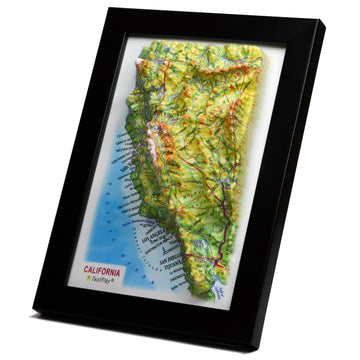
A raised relief map is a three-dimensional model of a region's terrain, where elevation is exaggerated (usually vertically) to make mountains, hills, valleys, and other landforms stand out. Unlike a standard flat map that uses symbols and lines to represent elevation changes, a relief map physically replicates the variations in the landscape. They are typically made from molded plastic or other durable materials, depicting not only the topography but also often including political boundaries, major bodies of water, and significant cities for context.
The key feature is the texture and form; you can run your fingers over the surface and feel the rise and fall of the land, trace the path of rivers carving through valleys, and sense the vastness of plains or the ruggedness of mountain ranges. This tactile element is not merely a novelty; it is a core component of its educational power, engaging senses beyond just sight. While vertical exaggeration is necessary to make subtle elevation differences noticeable, the map still accurately portrays the *relative* shapes and positions of landforms.
The Difference Makers: Flat vs. Relief Maps
The contrast between a flat map and a raised relief map highlights the latter's unique benefits for spatial understanding. A flat map relies on abstract symbols – contour lines, color gradients, or shading – to indicate elevation. Interpreting these symbols requires a certain level of abstract thinking and the ability to translate a 2D representation into a 3D mental image, which can be challenging for many students, especially younger ones or those who are visual or kinesthetic learners.
A raised relief map bypasses much of this abstraction by providing a direct, concrete model of the terrain. Students don't have to *imagine* what a mountain range looks like based on concentric circles; they can *see* and *feel* its physical form. This direct sensory input makes geographic concepts more intuitive, more memorable, and significantly easier to internalize. It transforms geography from an exercise in symbol interpretation into an exploration of the physical world.
Engaging Minds Through Tactile Exploration
One of the most immediate and noticeable benefits of introducing a raised relief map into a classroom is the dramatic increase in student engagement. In a world saturated with passive screen time, a large, physical, three-dimensional object that students are encouraged to touch and explore is inherently captivating. It invites curiosity and interaction in a way that static images or even interactive flat-map apps often cannot.
The simple act of touching the map, tracing features with their fingers, and seeing the landscape pop out in 3D creates an immediate connection to the material. This tactile engagement is particularly effective for students who thrive with hands-on learning or who may struggle with purely visual or auditory instruction. It provides an alternative pathway to understanding that can reach students who might otherwise feel disconnected from traditional geography lessons.
Sparking Curiosity and Wonder
A raised relief map is a powerful catalyst for curiosity. Students are naturally drawn to its unique texture and form. Questions arise spontaneously: "Why are these mountains so high here?" "Why does the river follow this path?" "What's in that big valley?" The map serves as a visual and tactile prompt, encouraging students to ask "why" and "how" questions about the Earth's surface and the forces that shape it.
This intrinsic motivation to explore and understand the physical landscape is invaluable for fostering a love of learning and discovery. The map isn't just a teaching tool; it's an artifact that sparks imagination and wonder about the vast and varied planet we inhabit. It makes the study of geography feel less like memorizing facts and more like solving mysteries about the world around us.
Catering to Different Learning Styles
Educators know that students learn in myriad ways – visually, auditorily, reading/writing, and kinesthetically. While many teaching tools cater well to the first three, resources that effectively engage kinesthetic and tactile learners can be harder to come by, especially in subjects like geography. Raised relief maps excel in this area, providing a rich sensory experience that benefits multiple learning styles simultaneously.
Visual learners benefit from seeing the landscape in realistic 3D. Tactile learners can feel the contours and forms. Kinesthetic learners can physically interact with the map, moving their hands over the terrain, tracing routes, and comparing elevations directly with their fingers. This multi-sensory approach ensures that a wider range of students can access and process geographic information effectively, making learning more inclusive and successful for everyone.
Making Geography Hands-On and Memorable
Learning by doing is a highly effective pedagogical approach, and a raised relief map makes geography inherently hands-on. Students can use the map to simulate geographic processes, like tracing how water would flow from a mountain peak down through valleys to a river or lake. They can plan hypothetical journeys, considering the challenges posed by different terrains. They can use string or rulers to measure distances "over the hills and through the woods."
These active learning experiences create stronger memory traces than passively viewing information. The physical interaction with the map embeds the concepts of elevation, slope, and landform relationships into students' understanding in a deep and lasting way. When they can physically feel the steepness of a mountain range they are studying, that concept becomes far more concrete and memorable than simply seeing contour lines on a flat page.
Deepening Geographic Understanding and Spatial Reasoning
Perhaps the most profound educational impact of raised relief maps lies in their ability to foster a deeper understanding of geography and to develop essential spatial reasoning skills. Geography is fundamentally about understanding the relationship between people, places, and environments across space and time. Spatial reasoning is the cognitive ability to think about objects in three dimensions and to understand their relationships to each other in space. These two concepts are deeply intertwined, and raised relief maps are uniquely positioned to teach them.
While flat maps are excellent for location and distance on a 2D plane, they struggle to intuitively convey the impact of terrain on human activity, climate, or ecosystems. Raised relief maps make these connections more apparent by showing the physical landscape in a way that mirrors reality more closely. This tangible representation is invaluable for building a robust understanding of how topography shapes the world.
Visualizing Topography and Landforms in 3D
The primary advantage is the ability to see and touch the actual shapes of mountains, valleys, plateaus, canyons, and other landforms. This immediate visual and tactile understanding eliminates the need for abstract interpretation of 2D symbols. Students can instantly see the difference between a broad, flat plain and a rugged mountain range, or the way a river has carved a deep valley over time.
This 3D visualization helps students build accurate mental models of geographic regions. When they study the Rocky Mountains, they don't just see jagged lines; they see a towering, complex range with distinct peaks and valleys. When they learn about the Amazon Basin, they see a vast, relatively flat expanse laced with rivers. This concrete understanding forms a solid foundation for all subsequent geographic learning.
Grasping Concepts Like Elevation, Slope, and Water Flow
Abstract concepts such as elevation, slope, drainage basins, and watersheds become much more intuitive when demonstrated on a raised surface. Teachers can use the map to show how elevation changes across a region and explain what those changes mean for temperature, vegetation, and human settlement. The concept of slope becomes immediately apparent when students feel the steepness of a mountainside compared to a gentle hill.
Understanding water flow is dramatically enhanced. Students can visually follow the paths of rivers and streams from higher elevations down to lower ones, seeing how tributaries merge and how mountain ranges act as divides, separating different river systems. This helps them grasp the concept of a watershed – the area of land where all water drains to a common point – in a very concrete way. These are concepts that are notoriously difficult to teach effectively using only flat maps or diagrams.
Developing Essential Spatial Thinking Skills
Spatial thinking is not just important for geographers; it is a critical skill used in fields ranging from architecture and engineering to medicine and urban planning. It involves understanding location, distance, direction, relationships between objects in space, and how these things change over time or with different perspectives. Raised relief maps are exceptional tools for developing these skills.
By using the map, students practice skills like:
1. Interpreting scale in three dimensions. They learn that while the vertical scale is exaggerated, the horizontal distances and relative positions are accurate.
2. Understanding perspective. They can view the same region from different angles, imagining how the landscape would look from a particular vantage point.
3. Analyzing spatial relationships. They can see how the location of mountains affects the location of valleys, how rivers follow the lowest points, or how cities developed in certain areas due to terrain.
4. Mentally manipulating objects in space. They can imagine travelling across the terrain, anticipating challenges or opportunities presented by the landscape.
These skills are transferable and crucial for success in a wide variety of academic subjects and future careers. A raised relief map provides a low-stakes, engaging environment for students to practice and strengthen these fundamental cognitive abilities.
Supporting Curriculum Across Multiple Subjects
While the most obvious application of a raised relief map is in geography, its benefits extend far beyond a single subject. These maps are powerful interdisciplinary tools that can enrich lessons in history, social studies, earth science, environmental science, and even mathematics. Integrating the map into various parts of the curriculum reinforces learning and helps students see the interconnectedness of different fields of study.
Geography is not an isolated subject; it is the stage upon which human history unfolds and where natural processes occur. Understanding the physical landscape is often essential to understanding events, patterns, and systems in other disciplines. A raised relief map makes these connections visible and understandable for students.
Geography and Earth Science Integration
This is the most direct application. In earth science, raised relief maps are invaluable for teaching about geological processes like plate tectonics, erosion, and glaciation. Students can visualize how mountains are formed, how rivers carve canyons, or how glaciers shape valleys. They can study different types of landforms depicted on the map – volcanic peaks, folded mountains, fault lines (if indicated), coastal plains – and understand the processes that created them.
The map provides a physical context for learning about different biomes and ecosystems, showing how altitude and terrain influence climate and vegetation. It helps students understand concepts like tree lines, rain shadows, and the distribution of plant and animal life based on geographical features.
Connecting to History and Social Studies
History and social studies are deeply rooted in geography. Understanding *where* events happened and *what the landscape was like* in that location is crucial for understanding *why* they happened the way they did. A raised relief map can illuminate countless historical narratives.
Consider migration patterns, trade routes, and military campaigns – all were heavily influenced by terrain. Why did people settle in valleys or near rivers? How did mountains act as barriers or natural defenses? Why was controlling a particular mountain pass or river system strategically important? A raised relief map allows students to visualize these geographical constraints and opportunities, providing critical context for historical events. It helps them understand, for example, why crossing the Alps was a major undertaking for Hannibal, or why control of the Mississippi River was vital during the American Civil War.
Enhancing Math and Science Concepts
Even subjects like math and science can benefit. In math, students can work with scale, calculating real-world distances and elevations based on the map's scale. They can explore concepts of ratio and proportion as they relate the map's vertical exaggeration to its horizontal scale. They can measure distances along winding rivers or mountain paths, applying geometric concepts in a practical context.
In science, beyond earth science, the map can be used to discuss environmental issues. Students can visualize the impact of pollution on a watershed, trace the potential path of contaminants, or study how changes in elevation affect weather patterns and climate zones. It provides a tangible model for understanding complex environmental systems and human impact on the landscape.
Practical Benefits and Classroom Integration
Beyond the pedagogical advantages, raised relief maps also offer practical benefits that make them suitable for the classroom environment. They are designed for repeated use and interaction, making them a worthwhile investment for educational institutions. Their versatility ensures they can be used in many different teaching scenarios and activities.
Integrating a raised relief map doesn't require a complete overhaul of teaching methods. Instead, it serves as an enhancement, a focal point, and a hands-on resource that can be incorporated into existing lessons to provide a richer, more engaging experience for students.
Durability and Longevity
Classroom resources need to withstand frequent handling by many students over many years. High-quality raised relief maps are typically constructed from durable, often vacuum-formed plastic, designed to be handled and touched. They are far more robust than paper maps and can endure the rigors of daily classroom use, making them a long-term resource. While they can be damaged by extreme misuse, they generally hold up very well to normal interaction, including tracing and pointing.
Versatility in Use (Individual, Group, Whole Class)
A raised relief map is incredibly versatile. It can be a focal point for whole-class instruction, used by the teacher to demonstrate concepts to everyone at once. It can be used in small group activities, allowing students to collaborate on tasks like identifying features, planning routes, or discussing the impact of geography on historical events.
It can also serve as a resource for individual student exploration or project work. A student researching a particular region can spend time examining its topography on the map, gaining insights that might be missed from a flat map or online image. This flexibility ensures the map can be utilized in various teaching strategies and learning setups within the classroom.
Making Learning Accessible for All Students
Raised relief maps offer unique accessibility benefits. For visually impaired students, the tactile nature provides a way to understand geographical shapes and forms that are inaccessible on a flat visual map. They can feel the mountains, valleys, and coastlines, gaining a spatial understanding through touch.
For students with dyslexia or other learning differences that might affect symbol interpretation, the direct, concrete representation of the landscape can be significantly easier to process than abstract contour lines. The multi-sensory input also supports students who benefit from engaging multiple senses simultaneously to process and retain information, making geography more accessible and less intimidating.
Choosing the Right Raised Relief Map for Your Classroom
Selecting a raised relief map requires considering the specific needs and focus of your curriculum and students. Not all maps are created equal, and factors like scale, area covered, level of detail, and durability can vary significantly. Investing in a high-quality, appropriate map ensures it will be a valuable and frequently used resource for years to come.
Thinking carefully about these factors before purchasing will help you choose a map that maximizes its educational impact and fits seamlessly into your teaching goals. A well-chosen map becomes a centerpiece of geographic learning.
Factors to Consider
Several factors should guide your selection process:
1. Area Covered: Do you need a map of the world, a continent, a specific country (like the United States), a state, or a smaller region? The scope should align with your curriculum's primary focus areas.
2. Scale: The scale determines how much detail is visible and the overall size of the map. A smaller scale map covers a larger area but shows less detail, while a larger scale map covers a smaller area but shows more intricate topography. Consider what level of detail is appropriate for your students' age and curriculum objectives.
3. Vertical Exaggeration: Raised relief maps exaggerate vertical scale compared to horizontal scale to make landforms visible. The amount of exaggeration varies. While necessary, excessive exaggeration can sometimes give a misleading impression of the land's true steepness. Look for a balance that clearly shows topography without being overly distorted.
4. Material and Durability: Choose a map made from sturdy, easy-to-clean material. Molded plastic is common and durable. Check reviews or product descriptions for information on how well the map holds up to frequent handling.
5. Detail and Labeling: Consider what information is included beyond topography. Does it show political boundaries, cities, rivers, lakes, and major peaks? Is the labeling clear and easy to read? Some maps focus purely on physical relief, while others combine physical and political information.
Maintenance and Care
Proper care will extend the life of your raised relief map. Most are made of materials that can be wiped clean with a damp cloth, which is important for a classroom resource that gets touched frequently. Avoid harsh chemicals or abrasive cleaners, as these can damage the surface or fade the colors. Store the map flat or rolled according to manufacturer instructions to prevent warping or cracking, especially if it's a larger format map. Hanging it securely on a wall is often the best way to keep it accessible and prevent damage.
Realizing the Potential: How to Maximize the Impact of Your Map
Simply having a raised relief map in the classroom is a good start, but actively integrating it into lessons and activities is key to unlocking its full potential. The map should be a dynamic tool, not just a static display. Encourage students to use it frequently, both during structured lessons and during free exploration time.
Think creatively about how the map can be used to introduce new concepts, reinforce learning, facilitate discussions, and support student projects. The more interactive and hands-on the activities, the greater the impact the map will have on student understanding and engagement.
Interactive Activities and Lesson Ideas
Here are a few ideas for incorporating a raised relief map into your teaching:
1. Topography Scavenger Hunt: Provide students with a list of landforms or features (e.g., a specific mountain peak, the longest river, a major lake, a significant valley) and have them locate and identify them on the map, perhaps describing their characteristics based on the relief.
2. Route Planning Challenge: Ask students to plan a hypothetical journey between two points, considering the terrain shown on the map. What challenges would mountains or rivers present? What would be the easiest path? How would the route differ on a flat map?
3. Simulating Water Flow: Use a spray bottle with water (sparingly!) or simply trace with fingers to demonstrate how water would flow across the landscape, following valleys and collecting in low-lying areas, illustrating watersheds and drainage patterns.
4. Connecting Geography to Current Events or History: When discussing a news event or historical occurrence related to a specific region, use the relief map to show students the landscape and discuss how it might have influenced the event. For example, discussing the terrain of Afghanistan when learning about its recent history.
5. Landform Creation Comparison: Pair the relief map with information on geological processes. Have students identify examples of different landforms (volcanic mountains, folded mountains, glacial valleys) on the map and discuss the forces that likely shaped them.
6. Elevation Profile Drawing: Choose a line across a varied part of the map and have students try to draw a side-view elevation profile based on the map's relief. This is an excellent exercise in translating 3D information into a 2D graph.
Encouraging Student-Led Exploration
Beyond structured activities, simply making the map accessible for student exploration is beneficial. Mount it on a wall where students can easily reach and touch it during downtime or when they finish other work. Encourage them to explore it, ask questions, and discuss their observations with classmates. A curious student might spend time tracing a river system or comparing the height of different mountain ranges, reinforcing their learning organically. This free exploration fosters a sense of ownership and personal connection to the map and the geographic concepts it represents.
Conclusion
In conclusion, while digital resources and flat maps serve important functions in education, the raised relief map offers a unique and indispensable set of benefits that are vital for fostering deep geographic understanding and critical spatial thinking skills. Its ability to provide a tangible, multi-sensory representation of the Earth's surface directly addresses the challenges of teaching abstract concepts in a 2D world.
From sparking immediate engagement and catering to diverse learning styles through tactile exploration, to providing a concrete foundation for understanding complex concepts like elevation, slope, and watersheds, the educational value of raised relief maps is clear and compelling. They serve not only as powerful tools for geography and earth science but also as versatile resources that enrich the study of history, social studies, and even math and environmental science, helping students see the interconnectedness of their world.
Investing in a durable, high-quality raised relief map is an investment in a resource that will enhance learning for years to come, providing a hands-on, intuitive pathway to understanding the physical world for every student. In the modern classroom, where the goal is to equip students with a comprehensive understanding of their planet and the skills to navigate its complexities, a raised relief map is not a luxury; it is an essential tool for bringing geography to life.