

Maps are more than just lines on a page; they are windows into our world, tools for exploration, and records of human understanding.
From the earliest scratchings on clay tablets to the sophisticated digital interfaces we use today, the art and science of cartography have undergone a breathtaking transformation.
For anyone fascinated by geography, history, or simply how we've come to understand the physical space around us, exploring this evolution is a truly rewarding journey.
This post will guide you through the incredible history of mapmaking, highlighting the pivotal shifts that took us from simple flat representations to complex, three-dimensional raised relief maps and beyond, offering a comprehensive look at how our perspective of the Earth has changed over millennia.
Maps serve an intrinsic human need: to comprehend our environment and our place within it.
They are essential for navigation, planning, resource management, and even storytelling.
Throughout history, the quality and availability of maps have directly impacted everything from trade routes and military strategy to scientific discovery and personal travel.
Understanding their history helps us appreciate their power and the ingenuity required to create them.
Our journey begins with the very first attempts to represent the Earth's surface, primarily on flat mediums.
We will trace the development of techniques, the impact of technological advancements, and the growing desire for more accurate and informative depictions.
A significant part of this evolution involves the challenge of representing the Earth's varied terrain, leading us eventually to the innovation of raised relief maps that literally add a new dimension to our understanding.
Buckle up for a deep dive into the fascinating world of cartographic evolution.
The oldest known maps date back thousands of years, long before formal cartography existed.
These early examples, found on materials like clay tablets or cave walls, were often rudimentary, depicting local areas, land ownership, or astronomical observations.
While not accurate in a modern sense, they demonstrate humanity's early desire to document and share spatial information.
They represent foundational steps in visual communication about place.
Examples include the Babylonian map of the world (circa 6th century BCE), which is more schematic than geographically precise but shows Babylon at the center of a circular world surrounded by water.
Indigenous cultures around the globe also developed mapping traditions, using materials like sticks (e.g., Marshall Islands stick charts for navigation) or drawing on skin or sand.
These early efforts were often focused on practical immediate needs rather than a global view.
The Greeks were pioneers in applying mathematical and philosophical principles to geography, laying the groundwork for scientific cartography.
Thinkers like Anaximander are credited with creating early world maps, though none survive.
Eratosthenes famously calculated the Earth's circumference with remarkable accuracy in the 3rd century BCE, proving the Earth was spherical and providing a basis for more accurate scale on maps.
Perhaps the most influential figure from this era was Claudius Ptolemy, a Greco-Roman scholar from the 2nd century CE.
His work *Geographia* compiled existing geographical knowledge and, crucially, provided instructions for drawing maps using a coordinate system of latitude and longitude.
Although his world map contained significant errors (like underestimating the Earth's size and extending Asia too far east), his systematic approach was incredibly influential for over a thousand years.
Ptolemy's work represents a major step towards scientific cartography, moving beyond simple sketches to measured, systematic representations based on known locations and astronomical data.
The late medieval period and the Renaissance ushered in the Age of Exploration, a time of unprecedented maritime voyages across oceans.
Explorers sailing to distant lands – across the Atlantic, around Africa, and eventually to the Americas and Asia – desperately needed accurate maps for navigation.
Existing maps, often based on Ptolemy's work or medieval *Mappae Mundi* (which were often more theological diagrams than navigational tools), were insufficient and frequently misleading for long-distance sea travel.
The demand for better charts spurred significant innovation in mapmaking.
Navigators required maps that could accurately represent distances and, critically, directions (bearings) for plotting courses.
This era saw the rise of *portolan* charts, detailed manuscript maps of coasts based on compass directions and estimated distances observed by sailors.
While excellent for coastal navigation, they did not accurately represent the curvature of the Earth over vast distances.
One of the fundamental challenges in mapmaking is representing a three-dimensional spherical object (Earth) on a two-dimensional flat surface.
This process, known as map projection, inevitably introduces distortion.
Different projections distort different properties: some distort area, some distort shape, some distort distance, and some distort direction.
For the navigators of the Age of Exploration, preserving true direction was paramount.
Gerardus Mercator, a Flemish cartographer, addressed this need in 1569 with his revolutionary world map using what is now known as the Mercator projection.
This projection is a cylindrical projection that projects the globe onto a cylinder tangent to the equator, then unrolls the cylinder.
Its key feature is that lines of constant bearing (rhumb lines) are represented as straight lines, making it ideal for oceanic navigation using a compass.
Plotting a constant course became straightforward.
However, the Mercator projection significantly distorts area, especially near the poles.
Landmasses far from the equator appear much larger than they are in reality (e.g., Greenland appears vast, nearly as large as Africa, when Africa is fourteen times its size).
Despite this distortion, its utility for navigation made it the standard for nautical charts for centuries.
It also became widely used for world maps in atlases, shaping public perception of continent sizes for generations, a consequence not fully appreciated until later.
The invention of the movable type printing press in the 15th century had a profound impact on mapmaking.
Before printing, maps were hand-drawn manuscripts, rare, expensive, and prone to errors during copying.
Printing allowed for the mass production of maps, making them more accessible and affordable.
It also ensured consistency, as many identical copies could be made from a single master plate.
Techniques like woodcuts and later copperplate engraving became standard for producing maps.
Engraving, in particular, allowed for much finer detail and line work than woodcuts.
This led to the creation of the first modern atlases, collections of maps bound together, which became popular and influential tools for understanding the world.
The printing press democratized access to geographical knowledge, enabling wider distribution of new discoveries and improved cartographic techniques.
Creating accurate maps requires precise measurements of the Earth's surface, a process known as surveying.
Over centuries, surveying techniques evolved dramatically, moving from simple pacing and compass bearings to sophisticated triangulation and later, celestial observations.
The development of instruments like the theodolite allowed for more precise measurement of angles.
Governments began conducting systematic national surveys to create detailed and accurate topographic maps of their territories, essential for administration, taxation, and military purposes.
Large-scale surveys, such as the mapping of France by the Cassini family starting in the late 17th century, took generations but resulted in unprecedentedly accurate maps based on rigorous geodetic principles.
These detailed flat maps, incorporating measured distances and angles, represented the pinnacle of pre-modern flat cartography.
They laid the foundation for understanding local and regional geography in detail.
As maps became more detailed and complex, there arose a need for standardized symbols to represent various features consistently.
Symbols for roads, rivers, forests, buildings, political boundaries, and elevation lines (which we will discuss shortly) were developed and adopted.
This standardization made maps easier to read and interpret across different regions and by different users.
Cartographers also began to include more thematic information on maps, such as population density, geological data, or climate zones, moving beyond just physical geography.
The development of map legends or keys became crucial, explaining the meaning of the symbols and colors used.
This era of refinement in flat mapping focused not only on improving accuracy but also on enhancing the map's ability to communicate diverse types of information effectively.
Flat maps became increasingly sophisticated tools for analysis and planning, not just navigation.
While flat maps excelled at showing horizontal locations and distances, they struggled to represent the Earth's vertical dimension – its topography, the hills, mountains, valleys, and plains that define the landscape.
Knowing the terrain is crucial for many applications: military movements, infrastructure planning (roads, canals), agriculture, and simply understanding the physical character of a region.
Early mapmakers recognized this limitation and began experimenting with ways to depict relief on a two-dimensional surface.
Some of the earliest methods for showing relief on flat maps were pictorial or illustrative.
*Molehills*, or small mounds drawn in perspective, were used in medieval maps to suggest mountains.
Later, more systematic techniques emerged.
*Hachures* are short lines drawn in the direction of the steepest slope.
They are thicker and closer together for steeper slopes and thinner and more spaced out for gentle slopes, creating a visual sense of texture and inclination.
While effective for showing the *direction* and relative *steepness* of slopes, hachures do not provide precise information about elevation.
*Hill shading*, or *shaded relief*, involves simulating the effect of light and shadow on terrain.
By imagining a light source (often from the upper-left), mapmakers could darken slopes facing away from the light and lighten those facing towards it.
This creates a powerful visual impression of three-dimensionality and terrain shape.
Like hachures, shading is excellent for visualizing landforms but does not give specific elevation values.
The most significant breakthrough in representing precise elevation on flat maps was the invention and widespread adoption of contour lines.
A contour line connects points of equal elevation above a reference point (usually sea level).
Imagine slicing through a mountain horizontally at regular height intervals; the contour lines represent the outline of the mountain at each slice.
They were first conceived for hydrographic charting to show water depth (isobaths) in the 17th century and later adapted for land elevation (contours or isolines) in the 18th and 19th centuries.
Contour lines provide quantitative information about elevation.
Where lines are close together, the slope is steep; where they are far apart, the slope is gentle.
Closed loops indicate hills or depressions.
The *contour interval* (the difference in elevation between adjacent lines) is constant for a given map, allowing users to determine the approximate height of any point.
Contour lines revolutionized topographic mapping, providing the data needed to create accurate profiles and understand terrain quantitatively, paving the way for more advanced representations.
While contour lines provide data about elevation on a flat map, they still require interpretation to fully visualize the terrain.
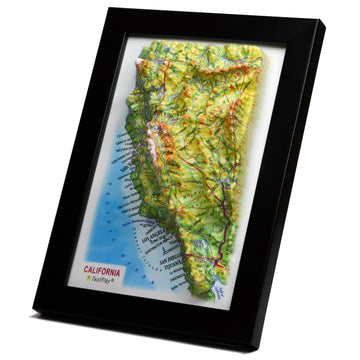
Raised relief maps take this a step further by creating a physical, three-dimensional model of the landscape.
These maps represent not only the horizontal location of features but also the vertical dimension through variations in height.
You can literally feel the mountains and valleys.
Raised relief maps offer an intuitive understanding of topography that flat maps, even those with contours or shading, cannot fully replicate.
They make elevation differences immediately apparent and help users grasp the shape and scale of landforms in a way that is both educational and engaging.
They bridge the gap between abstract data and physical reality.
Creating raised relief maps is a multi-step process that combines cartography, data processing, and manufacturing techniques.
The process typically begins with accurate topographic data, often derived from surveys, contour maps, or, in modern times, digital elevation models (DEMs) generated from satellite imagery or aerial lidar.
This elevation data is then processed and often exaggerated vertically (the vertical scale is usually greater than the horizontal scale to make relief more apparent, especially for areas with subtle topography).
The key manufacturing step involves creating a physical form or mold that represents the raised terrain.
Historically, this might have involved hand-sculpting, but modern techniques use computer-controlled milling machines to carve the relief into a master mold.
Once the mold is ready, a flat map sheet (printed with geographical details like rivers, roads, names, and even shaded relief or color tints corresponding to elevation) is heated and placed over the mold.
Using vacuum forming or pressure, the heated plastic sheet is stretched and molded to conform to the shape of the relief underneath.
After cooling and trimming, the result is a durable, lightweight map where the printed details align perfectly with the underlying three-dimensional form.
Raised relief maps have found diverse applications across various fields.
They are invaluable educational tools in schools, helping students visualize geographic concepts like watersheds, mountain ranges, and plateaus.
Hikers and outdoor enthusiasts use them for planning routes and understanding the terrain they will encounter.
Geologists, urban planners, and engineers use them for analysis and visualization.
They are also popular as decorative items, offering a striking visual representation of a favorite region or the entire world.
The primary advantage is the intuitive understanding of topography they provide.
They are also durable and can be touched and felt, offering a tactile learning experience.
However, they have limitations; they are bulky to store and transport, and the vertical exaggeration necessary to show relief can sometimes distort the true steepness of slopes.
Despite this, they remain a unique and effective way to represent the Earth's surface in three dimensions.
The advent of computers and digital technology in the late 20th century ushered in the most transformative era in mapmaking: the digital revolution.
Geographic Information Systems (GIS) allow users to capture, store, manage, analyze, and present all types of geographical data.
Unlike traditional maps, which are static representations, GIS allows for dynamic interaction with layers of spatial information.
You can overlay maps of roads, population density, soil types, elevation, and countless other datasets to perform complex analysis and create highly specific maps on demand.
GIS has become indispensable in almost every field imaginable, from environmental monitoring and urban planning to disaster response and market analysis.
It moves mapping beyond simple visualization to powerful spatial problem-solving.
Digital data, including digital elevation models (DEMs), provide the raw material for creating both sophisticated flat maps and digital 3D representations.
Another major digital advancement is the widespread availability of satellite and aerial imagery.
Satellites continuously image the Earth, providing up-to-date views of large areas.
Aerial photography and increasingly, drone imagery, offer even higher resolution views of local areas.
This imagery serves as a base layer for many digital maps, providing a realistic context for other geographic data.
It also allows for the creation of photorealistic maps and aids in detecting changes over time.
Satellites equipped with specialized sensors, like radar or lidar (Light Detection and Ranging), can also penetrate vegetation or capture detailed elevation data.
Lidar, in particular, is revolutionizing topographic mapping by creating highly accurate and detailed point clouds of the Earth's surface, which can then be used to generate extremely precise digital elevation models.
This data is far more detailed than previously possible with traditional surveying or contour lines.
Building upon digital elevation models and imagery, modern technology allows for the creation of highly detailed and interactive digital 3D maps.
Platforms like Google Earth or specialized GIS software can render landscapes in three dimensions, allowing users to pan, zoom, and tilt to view terrain from any angle.
Buildings and other features can be added as 3D models, creating realistic virtual environments.
This digital 3D representation offers many of the intuitive benefits of physical raised relief maps but with the flexibility and analytical power of digital data.
These digital models can be updated frequently with new data, incorporate real-time information (like weather or traffic), and be accessed on a wide range of devices.
While they lack the tactile feel of a physical raised map, their accessibility, detail, and interactivity make them incredibly powerful tools for visualization, planning, and exploration in the 21st century.
They represent a convergence of the desire for realistic terrain representation with the capabilities of modern computing.
Mapmaking continues to evolve rapidly.
The future promises maps that are even more dynamic, incorporating real-time data feeds for everything from traffic and weather to environmental sensors and social media activity.
This data will enable predictive mapping, allowing us to forecast changes and model potential scenarios.
Maps will become increasingly integrated with the Internet of Things, providing constantly updating information about our environment.
The static map is increasingly being replaced by the live map.
Future maps will likely be highly personalized, tailored to individual user needs and preferences.
Think augmented reality maps that overlay information onto the real world view through a phone or glasses, or maps that adapt their detail and focus based on the user's activity or location.
Accessibility will also improve, with more options for visually impaired users, perhaps incorporating haptic feedback or audio descriptions.
Mapping will become seamlessly integrated into our daily lives.
Even with the dominance of digital mapping, there might be a resurgence of interest in physical forms, perhaps driven by nostalgia, a desire for tangible objects, or the unique benefits of tactile representation (like raised relief).
New manufacturing techniques, such as 3D printing, could potentially make personalized physical maps, including raised relief, more accessible.
While they won't replace digital maps for navigation or analysis, physical maps, including raised relief, may continue to hold value for education, art, and a different kind of engagement with geography.
The journey from flat to raised relief is not just historical; it highlights an enduring human desire to touch and feel the landscape.
The evolution of mapmaking is a testament to human curiosity, ingenuity, and the persistent drive to understand and represent our world.
From the rudimentary sketches of antiquity and the navigational imperatives of the Age of Exploration to the scientific rigor of contour lines and the digital power of GIS and 3D modeling, each stage built upon the last.
The transition from purely flat representations to incorporating and ultimately physically modeling relief marks a significant step in capturing the Earth's true complexity.
Raised relief maps stand as a powerful symbol of this endeavor to add depth to our geographical understanding.
Today's mapmaking landscape is incredibly diverse, encompassing everything from traditional paper maps and raised relief models to dynamic online maps and immersive 3D environments.
Each form has its strengths and uses.
The journey from flat maps to raised relief and into the digital realm is not an end but a continuation of the story.
As technology advances and our needs change, maps will undoubtedly continue to evolve, helping us navigate, understand, and interact with our ever-changing planet in ways we can only begin to imagine.
The humble map, in all its forms, remains one of humanity's most essential tools.

TestPlayNA: Your Memories, Elevated: National Park & Ski Maps.