
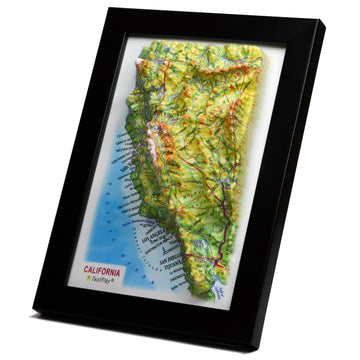



Have you ever gazed upon a seemingly flat map and wondered how it represents soaring mountains, deep valleys, or expansive plateaus? Standard two-dimensional maps can sometimes hide the dramatic three-dimensional reality of our planet's surface. Understanding the true shape of the land is crucial for everyone from hikers and geologists to urban planners and environmental scientists.
Relief maps, also known as topographic maps, are specifically designed to unveil this hidden world of elevation and landforms. They provide a visual language that describes slopes, heights, and shapes, allowing us to "see" the topography in intricate detail. But reading these maps effectively requires knowing how different geological features are depicted.
This comprehensive guide serves as your key to unlocking the secrets held within relief maps. We will delve into the fundamental principles of topographic representation and then explore how to identify and interpret a variety of key geological features. By the end, you will possess the skills to read the landscape directly from the map, enhancing your understanding of geology and improving your planning for outdoor adventures or scientific study.
Before we can identify specific features, it is essential to grasp the core methods relief maps use to represent three dimensions on a flat surface. The primary tool is the contour line, a concept fundamental to topography.
A contour line connects points of equal elevation above a reference point, usually sea level. Imagine slicing through a mountain at a specific height; the outline of that slice is a contour line. Every point along that line is at the same elevation.
The spacing between contour lines tells us about the steepness of the slope. Closely spaced contour lines indicate a steep slope, much like climbing a steep hill where you gain elevation quickly over a short horizontal distance. Widely spaced contour lines, conversely, show a gentle slope or relatively flat terrain, where you cover more horizontal ground to gain the same amount of elevation.
Another crucial element is the contour interval, which is the difference in elevation between consecutive contour lines. This interval is constant across a single map and is typically indicated in the map's legend. A small contour interval (e.g., 10 or 20 feet/meters) is used for flatter terrain or maps requiring fine detail, while a larger interval (e.g., 50 or 100 feet/meters) is common in mountainous regions where elevation changes rapidly.
Index contours are thicker or bolder contour lines that usually occur at every fifth contour line. They are often labeled with their elevation, making it easier to quickly determine approximate elevations on the map without counting every single line from a known point. These index contours provide essential reference points for interpreting the surrounding topography.
Beyond contour lines, relief maps often employ supplementary techniques to enhance the perception of terrain. Hillshading uses light and shadow to create a three-dimensional effect, typically by assuming a light source from the northwest. This visual shading helps the viewer quickly perceive the shape of hills and valleys, even before closely examining the contour lines.
Hypsometric tinting, or elevation coloring, uses different colors to represent distinct ranges of elevation. For example, green might represent lower elevations, transitioning through yellow and orange to brown or white for higher elevations. While not as precise as contour lines for determining exact elevation or slope, hypsometric tinting provides an immediate visual overview of the general elevation patterns across the mapped area.
Together, these elements – contour lines, contour interval, index contours, hillshading, and hypsometric tinting – combine to create a powerful representation of Earth's surface. Learning to read the patterns formed by these elements is key to understanding the geological features they depict.
Now that we understand the language of relief maps, we can apply this knowledge to identify and interpret specific geological features. Each type of landform leaves a unique signature in the arrangement of contour lines and the patterns of shading.
Mountains and isolated peaks are often the most striking features represented on a relief map. A peak is typically shown by a series of concentric, closed contour lines within a relatively small area.
The innermost contour line represents the highest elevation reached on that specific peak. The closer these concentric lines are to each other, the steeper the slopes of the mountain. If the lines are very far apart near the summit but become closer lower down, it indicates a peak with a relatively flat top but steep sides.
A mountain range is represented by a series of these closed contour patterns (peaks) connected by lines of higher elevation forming ridges. The orientation and length of these ridges define the overall shape and extent of the mountain range. Identifying saddles or passes between peaks, shown by dips in the contour lines along a ridge, is also crucial for understanding routes through mountainous terrain.
Valleys and canyons are common features carved by erosion, typically water or ice. On a relief map, valleys are characteristically represented by contour lines that form V-shapes or U-shapes.
For stream or river valleys formed by water erosion, the contour lines form V-shapes, and the pointed end of the V always points *upstream* (towards higher elevation). This is because water flows downhill, cutting across the contour lines. The steepness of the valley walls is indicated by the spacing of the contour lines forming the V.
Glacial valleys, often carved by ancient glaciers, are typically represented by U-shaped contours. These valleys tend to have broad, flat bottoms and steep, often rounded, sides, reflecting the erosive power and shape of a glacier compared to the focused cutting of a river. Recognizing the U-shape helps distinguish glaciated landscapes.
Depressions, areas lower than the surrounding terrain but not necessarily valleys, can also be identified. These are shown by closed contour lines that have hachures (short tick marks) pointing inward towards the center of the depression. This indicates that the elevation is decreasing as you move towards the center of the closed loop of contour lines. Examples include sinkholes, volcanic calderas, or kettles left by melting ice blocks.
Plateaus and mesas are elevated areas of land with relatively flat tops and steep sides, often formed by differential erosion wearing away softer rock layers around a harder caprock. On a relief map, these features have a distinctive appearance.
The flat top of a plateau or mesa is represented by an area of widely spaced or relatively few contour lines at a high elevation. This indicates minimal change in elevation across the summit surface. The edges of these landforms are marked by a sudden clustering of very closely spaced contour lines.
This tight clustering represents the steep cliffs or escarpments that define the sides of the plateau or mesa. A mesa is essentially a smaller, isolated plateau, often appearing as a small, flat-topped hill with steep sides, whereas a plateau covers a much larger area. Identifying these patterns allows you to distinguish these elevated, flat surfaces from rounded mountains or hills.
Ridges and escarpments are elongated landforms that represent changes in elevation along a line. A ridge is a long, narrow elevation feature, often forming the crest of a hill or mountain range.
On a relief map, a ridge is shown by contour lines that are elongated along a particular direction. The contour lines will typically curve around the ridge, showing higher elevation along its crest and descending slopes on either side. The tightness of the curves and spacing of the lines indicate the steepness and shape of the ridge.
An escarpment, also known as a scarp, is a long, steep slope or cliff that forms a boundary between areas of different elevations. It is essentially the steep face of a plateau, mesa, or fault block. On a relief map, an escarpment is represented by a tight band of very closely spaced or even merging contour lines running parallel to each other along a significant distance.
Recognizing these linear patterns helps understand the structural trends in the landscape, whether it is a fold in rock layers forming a ridge or a fault creating a dramatic drop in elevation along an escarpment.
Areas that were once covered by glaciers have distinct landforms that appear uniquely on relief maps. Glacial erosion and deposition create features quite different from those shaped primarily by water.
As mentioned, glacial valleys are typically U-shaped with broad, flat bottoms and steep sides. Cirques are bowl-shaped depressions found at the heads of glacial valleys, often ringed by steep cliffs; they appear as semi-circular areas of very closely spaced contours surrounding a flatter or inwardly sloping area.
Moraines are ridges or mounds of rock debris deposited by a glacier. Terminal moraines, marking the furthest extent of a glacier, appear as curving ridges of contour lines. Lateral moraines run along the sides of a glacial valley, shown as linear ridges parallel to the valley walls. These depositional features can significantly alter the local relief.
Rivers and streams are powerful agents of erosion and deposition, creating a variety of fluvial landforms readily visible on relief maps, often in conjunction with the V-shaped valleys they carve.
The path of a river is usually marked on a topographic map, often with symbols indicating flow direction. The valley floor through which the river flows may show patterns of meandering channels, particularly in flatter areas. Contour lines in floodplains (flat areas adjacent to rivers that are subject to flooding) are typically very widely spaced, showing minimal elevation change.
Alluvial fans, cone-shaped deposits of sediment where a stream emerges from a steep valley onto a flatter area, appear as fan-shaped patterns of gently sloping contours radiating outward from a point source. Deltas, formed where rivers enter larger bodies of water, show complex, low-relief areas with intricate networks of channels and very subtle changes in elevation.
Karst topography, formed by the dissolution of soluble rocks like limestone, gypsum, and dolomite, presents unique challenges and features on relief maps. While many karst features are subsurface (caves), their surface expressions can sometimes be identified.
Sinkholes are the most common surface feature, formed when the ground surface collapses into an underground cavity. Larger sinkholes or dolines appear on relief maps as closed depressions, often with hachured contour lines pointing inward, similar to other depressions but potentially numerous and clustered in karst regions.
While caves themselves are not directly shown on standard relief maps as they are underground voids, their presence can be inferred from the characteristic surface features and the underlying geology (often indicated on geological maps accompanying the topographic map). Understanding the surface relief patterns in a karst area can help identify potential areas of subsurface cave development.
Relief maps extend to the coast, providing crucial information about the transition from land to water. Coastal features are heavily influenced by the interaction between terrestrial processes shaping the land and marine processes shaping the shoreline.
Coastal cliffs are represented by very closely spaced contour lines dropping steeply towards the shoreline. Bays and coves show contours that curve inward from the general trend of the coastline, indicating indentations in the landmass. Headlands and peninsulas show contours curving outward, representing landmasses protruding into the water.
Areas with beaches and coastal plains will show widely spaced contour lines near the shoreline, indicating flat, low-lying terrain. Relief maps, especially those designed for coastal areas, may also include bathymetric data (underwater contours showing depth), though this is not strictly "relief" of the land surface itself.
Interpreting individual features is powerful, but the true skill lies in reading how these features relate to each other to tell the story of the landscape's formation and ongoing processes. Relief maps are not just static pictures; they capture dynamic geological history.
For instance, observing how V-shaped stream valleys cut through mountain ridges shows the ongoing process of erosion shaping the land. Identifying U-shaped valleys alongside sharp, unglaciated peaks in the same region can reveal the extent and impact of past glaciation. Noticing how rivers meander across wide, flat plains below steep mountain fronts illustrates the transition from erosional to depositional environments.
A landscape on a relief map is a complex tapestry woven from geological forces, climate, and time. By identifying the patterns of mountains, valleys, plateaus, and other features and considering their arrangement and shape, you can begin to understand the underlying geology, the history of erosion and deposition, and the processes currently shaping the terrain.
The ability to interpret geological features on relief maps has numerous practical applications across various fields. Whether you are pursuing a hobby or a profession, mastering this skill is invaluable.
Here are some key areas where this knowledge is applied:
Beyond traditional paper maps, digital relief maps and 3D topographic models available through GIS (Geographic Information Systems) software and online platforms offer even more powerful ways to visualize and analyze terrain. These digital tools often allow for dynamic viewing angles, layering of different data sets (like geology or vegetation), and precise measurement of distances and elevations.
Exploring these digital resources, alongside practicing with traditional paper maps, will further enhance your ability to interpret the intricate details of Earth's surface relief.
Relief maps are far more than just flat representations of bumpy ground; they are sophisticated tools that decode the complex story written on Earth's surface. By mastering the interpretation of contour lines, shading, and other map elements, you gain the ability to identify and understand a vast array of geological features, from towering mountains and deep valleys to subtle ridges and hidden sinkholes.
The skill of reading the landscape from a map connects you more deeply to the natural world, enhances your safety and enjoyment in outdoor activities, and provides essential insights for scientific and professional pursuits. Each line and curve on a relief map holds information about elevation, slope, and shape, waiting to be discovered.
We encourage you to pick up a relief map of a familiar area and begin practicing. Start by identifying major features you know and then look for smaller details. With practice, the patterns will become clear, and you will unlock a new level of understanding of the incredible, dynamic surface of our planet.

TestPlayNA: Your Memories, Elevated: National Park & Ski Maps.