

At first glance, a world globe might seem like a simple, spherical map. It sits on a desk, perhaps gathering dust, a static representation of our planet. Many of us encountered globes in classrooms, spinning them idly while learning country names and continents.
However, these beautiful objects hold a history and complexity far richer than their unassuming presence suggests. From their ancient origins to the intricate details of their creation and their surprising evolution, globes are packed with stories and fascinating facts. They are more than just geographical tools; they are artifacts of human knowledge, exploration, and artistry.
This post delves deep into the world of globes, unveiling ten amazing facts you probably didn't know. Prepare to gain a new appreciation for these enduring symbols of global understanding. We will explore their surprising history, the clever science behind their design, and their place in our modern world, offering a comprehensive look at why globes remain relevant and captivating.
Let's embark on a journey around the globe, not just across its surface, but into its very essence. These ten facts reveal the hidden depths and fascinating story behind the world globe. Each one sheds light on a different aspect of their creation, history, or significance, building a complete picture of these remarkable items. Prepare to have your perspective on globes completely transformed.
While the globes we recognize today largely developed in the Renaissance, the concept of representing the Earth spherically is ancient. Early Greek philosophers and geographers understood the Earth was round and even attempted to create spherical models. Thinkers like Crates of Mallus are credited with making one of the earliest known globes around 150 BCE.
These initial attempts were theoretical and likely not detailed maps of the known world as we understand them today. They were philosophical models demonstrating the Earth's shape rather than practical tools for navigation or geography. This early understanding laid the groundwork for later, more sophisticated attempts to map the world onto a sphere, demonstrating a long-standing human desire to comprehend our planet's true form. The idea of a globe is therefore intertwined with the very origins of scientific inquiry into the Earth's shape.
When we talk about surviving historical globes depicting the known world, the Erdapfel holds a special place. Created by Martin Behaim in Nuremberg in 1492, this globe is considered the oldest terrestrial globe still in existence. It's a remarkable artifact not just for its age, but for what it represents.
The Erdapfel, meaning "earth apple" in German, was completed just months before Christopher Columbus's first voyage reached the Americas. Consequently, it famously does not depict the New World, instead showing a vast, empty ocean between Europe and Asia, alongside speculative landmasses based on classical texts and Marco Polo's travels. This makes it an invaluable snapshot of geographical knowledge on the cusp of a major age of exploration, highlighting the state of the world map just before it dramatically changed forever. Its detailed craftsmanship, featuring painted illustrations and text, underscores the significant effort and artistry involved in creating such an object during that era.
Due to the limited extent of known and accurately surveyed lands, particularly in the early years of globe making, large areas were often left blank or filled with speculative information. Mapmakers relied on explorers' accounts, ancient texts, and sometimes pure conjecture to fill in the gaps. This means that early globes weren't just geographical tools; they were fascinating blends of known facts, rumors, myths, and artistic license.
Large continents might be misplaced, islands could be non-existent, and mythical creatures were sometimes included in the oceans or unknown lands. As exploration progressed, globes had to be constantly updated, becoming living documents that reflected the dynamic nature of geographical discovery. The process of updating was slow and laborious, often lagging significantly behind new discoveries. This constant state of flux makes studying historical globes a window into the evolving understanding of the world and the challenges of mapping it accurately without modern technology.
For centuries, owning a globe was a status symbol, a luxury reserved for royalty, wealthy merchants, scholars, and institutions. Creating a globe was an incredibly labor-intensive and expensive process. It required skilled craftsmen, cartographers, artists, and substantial materials like treated paper, plaster, and elaborate stands made of wood or metal.
Globes were often commissioned pieces, sometimes paired with a celestial globe showing the stars, further increasing their cost and prestige. Displaying a globe in one's study or library signaled intellectual curiosity, a connection to global affairs, and significant personal wealth. They were objects of curiosity, instruments for learning, and powerful decorative pieces that spoke volumes about the owner's standing and worldview. Their exclusivity meant that access to accurate global geography was limited to a privileged few, highlighting the link between knowledge, power, and resources in past centuries.
While terrestrial globes depicting the Earth are the most common, globemakers have long created other types of spherical representations. Celestial globes show the stars and constellations as seen from Earth's perspective, mapping the night sky onto a sphere. These were vital tools for astronomers and navigators, helping them understand the movements of celestial bodies and use them for orientation.
There are also lunar globes mapping the surface of the Moon, Martian globes mapping Mars, and even hypothetical globes showing the surface of other planets or moons. More recently, globes representing data other than physical geography have emerged, such as population distribution or climate patterns. This demonstrates the versatility of the spherical format for visualizing spatial information, extending the concept of a globe far beyond just our home planet and into the broader cosmos or abstract data sets.
Just like flat maps, globes are created using a specific scale, although it is often less explicitly stated on smaller, decorative globes. The scale indicates the ratio between a distance on the globe and the corresponding distance on the actual Earth's surface. Understanding the scale is crucial for using a globe as an accurate geographical tool.
A scale of 1:40,000,000, for example, means that one inch on the globe represents 40 million inches (or about 631 miles) on Earth. Larger, more detailed globes will have a "larger" scale (meaning the number after the colon is smaller, e.g., 1:10,000,000), allowing for more features like smaller cities, rivers, and topographical details to be included. The choice of scale dictates the level of detail possible and the overall size of the finished globe, balancing practical size constraints with the desire for geographical accuracy and information density.
Most modern globes are mounted on an axis and tilted at an angle of approximately 23.5 degrees relative to their base. This tilt is not arbitrary; it precisely mimics the axial tilt of the Earth in relation to its orbital plane around the Sun. This seemingly small detail is fundamentally important for understanding many geographical and astronomical phenomena.
The Earth's tilt is the primary reason we experience seasons. As the Earth orbits the Sun, different hemispheres are tilted towards or away from the sun at various points in the year, leading to variations in sunlight intensity and duration. A tilted globe allows users to visualize this concept directly, demonstrating why the Northern Hemisphere experiences summer when it's tilted towards the sun and winter when tilted away. It also helps explain phenomena like the midnight sun in polar regions and the variation in daylight hours throughout the year. The tilt transforms the globe from a static map into a dynamic model demonstrating fundamental Earth-Sun relationships.
The materials and methods used to create globes have evolved dramatically over the centuries. Early globes were often constructed by covering a sphere of wood or metal with plaster or gesso, onto which printed paper segments (gores) were pasted and then often hand-colored and varnished. This was a time-consuming and skilled process.
The invention of techniques like papier-mâché in the 18th and 19th centuries made globe production more accessible and affordable, although still a complex craft. Modern globes are typically made from lightweight, durable materials like plastic. Furthermore, the concept has expanded into the digital realm with interactive, virtual globes like Google Earth. These digital versions allow for unprecedented levels of detail, zoom capabilities, and layering of information, offering a new dimension to exploring our planet. Despite these technological advancements, traditional physical globes continue to be produced and valued for their tactile nature and classic aesthetic.
One of the most significant advantages of a globe over a flat map is its ability to represent the Earth's surface with minimal distortion of area, shape, distance, and direction. Any flat map of a spherical surface must inevitably distort some of these properties – it's a fundamental problem in cartography. The famous Mercator projection, for instance, accurately depicts shapes and angles but drastically exaggerates areas near the poles.
A globe, being a scale model of the Earth's sphere, avoids this distortion problem inherently. Distances, areas, and shapes are represented proportionally across the entire surface, making it the most accurate way to visualize the relative sizes and positions of continents and countries. Holding a globe allows one to grasp the true size of Greenland relative to Africa, or the curvature of a flight path, in a way that a flat map simply cannot replicate accurately across its entirety. This makes globes invaluable for teaching true spatial relationships and avoiding the misconceptions sometimes perpetuated by distorted flat maps.
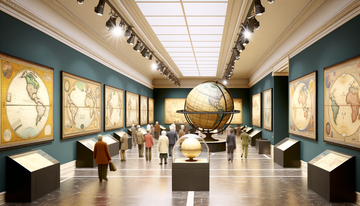
Beyond their function as geographical tools, globes have always been admired for their beauty and craftsmanship. Historical globes are considered significant works of art and historical artifacts, found in museums and prestigious collections worldwide. Their intricate details, beautiful cartography, and often elaborate stands make them stunning decorative pieces that tell a story of their time.
In the modern world, globes continue to be popular not only for educational purposes in schools and homes but also as stylish and meaningful decorative items. They serve as a constant reminder of our place in the world and the interconnectedness of all nations and environments. Whether a vintage replica, a sleek modern design, or an illuminated interactive model, a globe remains a powerful symbol of knowledge, exploration, and a global perspective, captivating people of all ages and backgrounds.
In an age dominated by digital maps on screens that fit in our pockets, one might wonder about the continued relevance of the physical world globe. Yet, as we have explored these ten fascinating facts, it becomes clear that globes offer something unique and irreplaceable. They provide a tactile, three-dimensional understanding of our planet that digital interfaces, while powerful, cannot fully replicate.
Globes allow for a tangible grasp of scale and relative size without the inherent distortions of flat projections. Spinning a globe provides an intuitive sense of the Earth's rotation and the relationships between different parts of the world. They serve as beautiful, educational pieces in homes and classrooms, sparking curiosity and facilitating learning in a direct, hands-on way. Moreover, they remain potent symbols of global citizenship and awareness.
The world globe, seemingly a simple object, is a marvel of history, science, and artistry. From the ancient Greeks' theoretical spheres to the priceless Erdapfel, the status symbols of Renaissance courts, and the interactive models of the 21st century, globes have a rich and complex story. They are not just maps; they are historical documents, works of craft, and educational tools that have helped shape our understanding of the Earth for millennia.
The next time you encounter a world globe, take a moment to look beyond the colored continents and oceans. Appreciate its long history, the ingenuity of its creators, and the profound significance of its simple, spherical form. It is a reminder of humanity's enduring quest to explore, understand, and map the world, a quest beautifully embodied in this humble yet extraordinary object. The globe truly unlocks the world, offering a perspective unlike any other.

TestPlayNA: Your Memories, Elevated: National Park & Ski Maps.